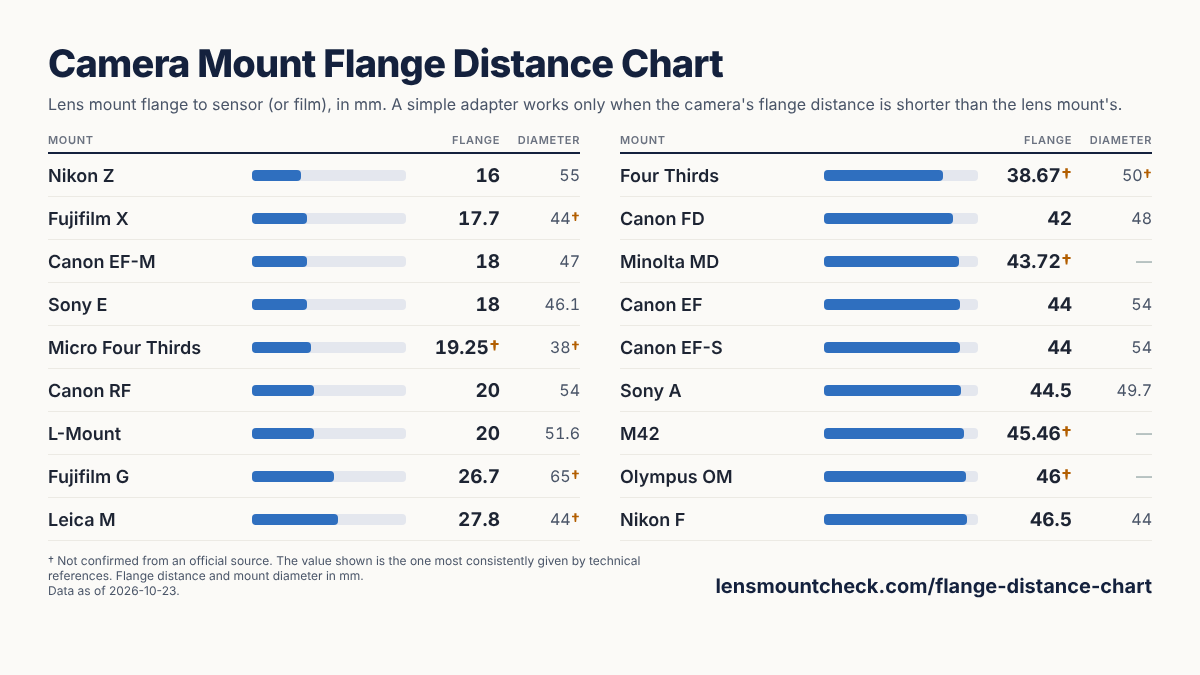
Flange distance (also called flange focal distance or flange back) is the distance from a camera’s lens mount to its sensor or film plane. It is one of the first things to check when you want to put a lens from one system on a camera from another. This chart lists the flange distance and mount diameter of every mount in our database, with links to the cameras and lenses that use each one.
How to read this chart
- Flange distance: the shorter the number, the closer the mount sits to the sensor. Mirrorless mounts are generally on the short end; SLR mounts are on the long end.
- Mount diameter: the inner diameter of the mount opening. It limits how large a lens throat can be, and can matter when adapting a lens from a wider mount to a narrower one.
- Cameras / Lenses: how many of each are registered in our database for that mount. Click a number to open the list filtered to that mount.
| Mount | Flange distance (mm) | Mount diameter (mm) | Cameras | Lenses |
|---|---|---|---|---|
| Nikon Z[1] | 16 | 55 | 15 | 117 |
| Fujifilm X[2] | 17.7 | 44 † | 36 | 148 |
| Canon EF-M | 18 | 47 | 11 | 65 |
| Sony E[3] | 18 | 46.1 | 49 | 317 |
| Micro Four Thirds | 19.25 † | 38 † | 87 | 151 |
| Canon RF[4] | 20 | 54 | 17 | 81 |
| L-Mount[5] | 20 | 51.6 | 19 | 86 |
| Fujifilm G[6] | 26.7 | 65 † | 8 | 20 |
| Leica M[7] | 27.8 | 44 † | 28 | 186 |
| Four Thirds[8] | 38.67 | 50 † | 18 | 28 |
| Canon FD[9] | 42 | 48 | — ‡ | 161 |
| Minolta MD[10] | 43.72 † | — | — ‡ | 99 |
| Canon EF[11] | 44 | 54 | 54 | 222 |
| Canon EF-S | 44 | 54 | — ‡ | 19 |
| Sony A[12] | 44.5 | 49.7 | 25 | 92 |
| M42[13] | 45.46 † | — | — ‡ | 147 |
| Olympus OM[14] | 46 † | — | — ‡ | 51 |
| Nikon F[15] | 46.5 | 44 | 54 | 290 |
† Not confirmed from an official source. The value shown is the one most consistently given by technical references.
‡ Lens-only mount. These lenses fit cameras registered under a related mount (for example, Canon EF-S lenses on EF-S-compatible cameras listed under Canon EF).
Sources: manufacturer pages unless marked technical reference (the basis for † values).
- Nikon Z — Flange distance and mount diameter: Nikon USA, “Nikon Z Series: Z Mount System”.
- Fujifilm X — Flange distance: FUJIFILM, “One lens one story #6”. Mount diameter: no source listed yet.
- Sony E — Flange distance: Sony Japan, NEX-5A features (Japanese). Mount diameter: no source listed yet.
- Canon RF — Flange distance and mount diameter: Canon Europe, “The RF mount explained”.
- L-Mount — Flange distance and mount diameter: L-Mount Alliance, “L for limitless”.
- Fujifilm G — Flange distance: FUJIFILM, “GFX Technologies #2”. Mount diameter: no source listed yet.
- Leica M — Flange distance: Leica Camera blog (January 2017). Mount diameter: Cornell mount register · LightPoint · Film and Digital Times (technical references).
- Four Thirds — Flange distance: Panasonic, AG-AF100 FAQ. Mount diameter: no source listed yet.
- Canon FD — Flange distance and mount diameter: Canon Camera Museum, Canon F-1 · Canon FX.
- Minolta MD — Flange distance: Cornell mount register (see [7]) (technical reference).
- Canon EF — Flange distance and mount diameter: Canon Europe, “The RF mount explained” (see [4]).
- Sony A — Flange distance: Sony Japan, α Ambassador vol.01 (edited meeting transcript, Japanese). Mount diameter: no source listed yet.
- M42 — Flange distance: Cornell mount register (see [7]) · japb.net (technical references).
- Olympus OM — Flange distance: Cornell mount register (see [7]) · japb.net (technical references).
- Nikon F — Flange distance: Nikon, Rayfact MJ95mm F-mount specifications (Japanese). Mount diameter: Nikon, “NIKKOR SLR Lenses — 45 Million and Counting” (2008).
Sources not yet listed for: Canon EF-M, Micro Four Thirds, Canon EF-S.
Compare two mounts
Pick the mount of your lens and the mount of your camera.
Choose a lens mount and a camera mount.
Save or share this chart
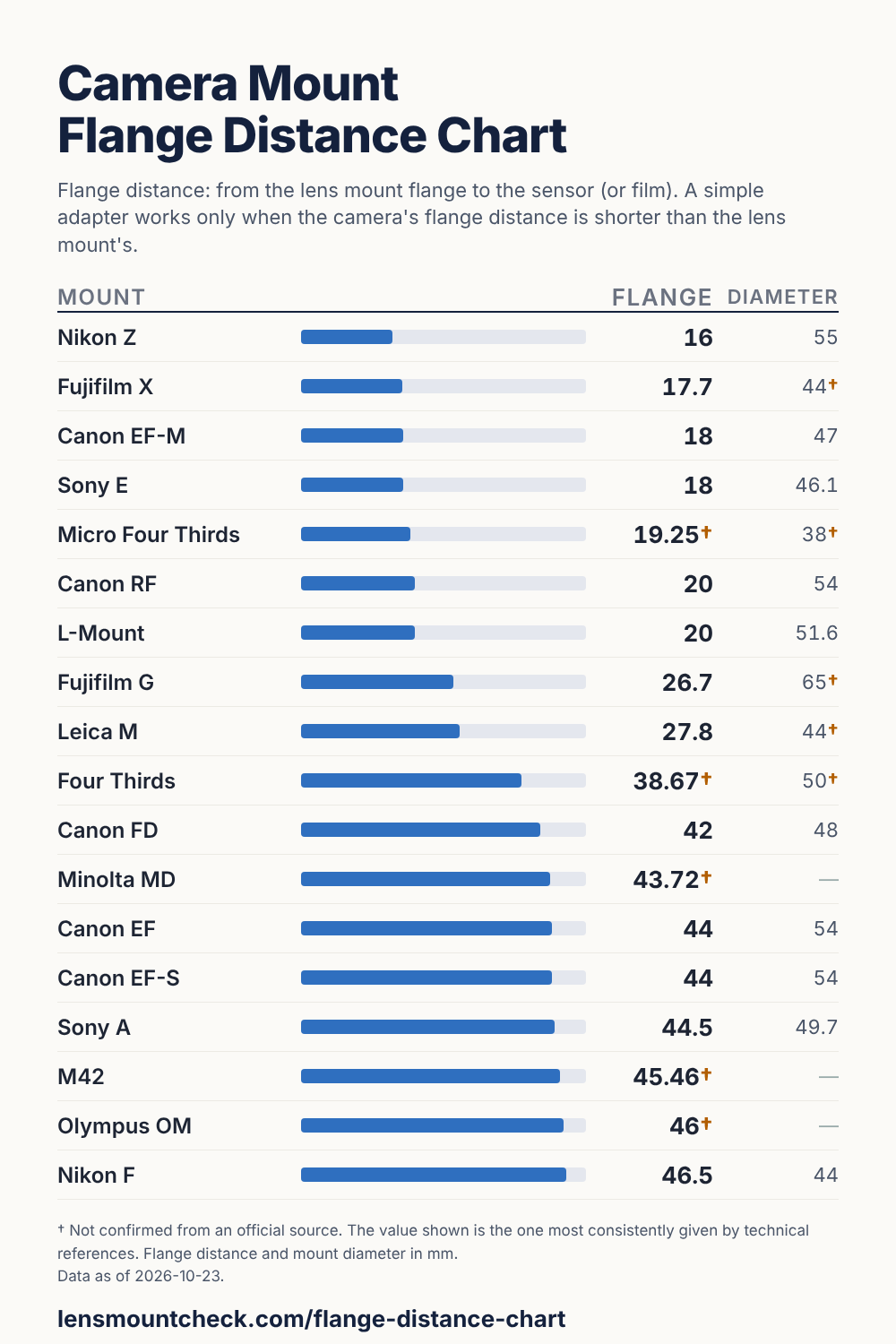
Free to share. Please keep the image unchanged and credit Lens Mount Check with a link to this page.
Download: vertical (1000×1500) · horizontal (1200×675)
Why flange distance matters for adapters
As a general rule, a lens can be adapted to a camera whose mount has a shorter flange distance, because the adapter fills the gap and keeps the lens at the right distance from the sensor. Going the other way usually needs an adapter with extra glass, which can affect image quality. Flange distance is only one part of compatibility: electronic contacts, autofocus drive, lens coverage and mount diameter all matter too. For a full explanation, read our guide What Is Flange Focal Distance, and Why Does It Matter for Lens Adapters?, and use the adapter database to check a specific combination.
Flange distance FAQ
What is flange distance?
Flange distance (flange focal distance, or flange back) is the distance from the camera’s lens mount to the sensor or film plane. Each mount has its own fixed value, which is why the same lens cannot simply be moved to another system.
What is the flange distance of Canon EF?
Canon EF lenses use a flange distance of 44 mm. Canon EF-S lenses share the same value, and the mirrorless Canon RF mount uses 20 mm.
Can I adapt a lens to a camera with a longer flange distance?
Generally not without optics. An adapter can only add distance, so a simple adapter works when the lens’s mount has the longer flange distance. Going the other way needs an adapter with glass, which changes image quality, or the lens will not focus to infinity.
How thick does an adapter need to be?
Roughly the lens mount’s flange distance minus the camera’s. For example, Canon EF to Sony E: 44 − 18 = 26 mm. Mechanical fit, electronics and autofocus are separate questions; see Canon EF to Sony E adapters for a specific pair.
What is the flange distance of Sony E?
Sony E uses a flange distance of 18 mm. Because it is short, many lenses made for SLR mounts can be used on Sony E cameras with a simple adapter, for example M42 to Sony E or Canon EF to Sony E.
Are Four Thirds and Micro Four Thirds the same mount?
No. Four Thirds is the SLR mount and Micro Four Thirds is the later mirrorless mount, so they have separate rows in this chart. Four Thirds lenses can be used on Micro Four Thirds cameras with an adapter; see Four Thirds to Micro Four Thirds.
When a listing only says “Four Thirds”, check the exact mount name in the manufacturer’s specifications before buying, rather than guessing from the product’s age, brand or appearance.
About these figures
Flange distance and mount diameter come from manufacturers’ official materials whenever we could confirm them. Where an official figure could not be confirmed, we mark it with † and say so. We update entries when we can verify a correction; to report an error, contact us.